Christ on the cold Stone
Diego de Mora
Granada, 1658 – 1729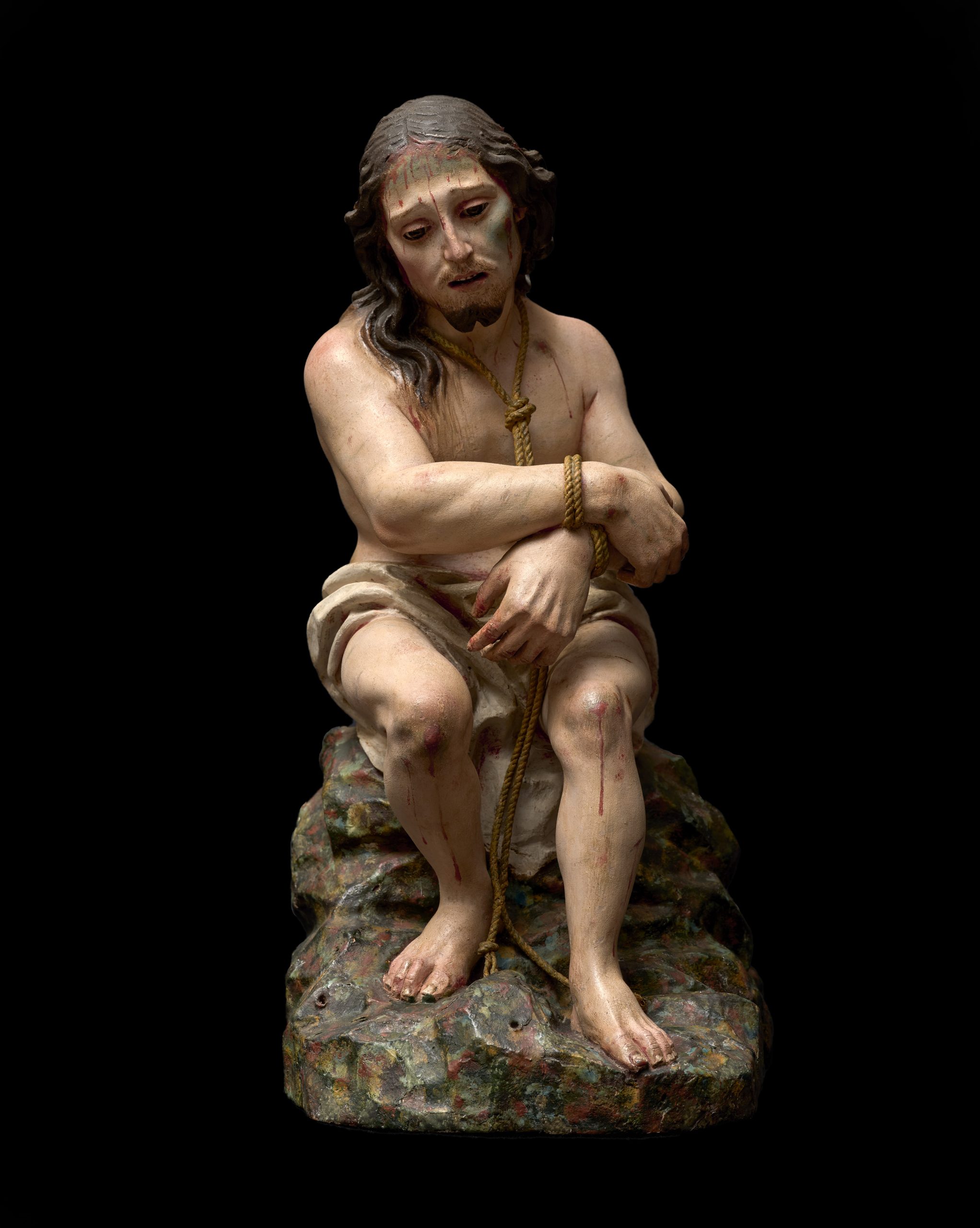
In this powerfully expressive image Christ is shown entirely alone and exhausted, awaiting the culminating moment of his Passion; his death on Golgotha. Seated on the cold stone, which is skilfully represented here as a coloured, rocky mass, his face reflects his absorption in his thoughts while his body is tensed. Naked apart from a small loincloth which is notable for the plasticity of the folds, the artist presents a powerful, carefully depicted body in slight contrapposto. With an expression of intense but restrained sadness charged with nobility and dignity, Christ is shown as bound by a piece of natural cord that extends around his neck.
He has large, sunken eyes below pronounced brow ridges, an angular nose and prominent cheekbones, while the gaunt, bloody face adheres to the typical Mora family model.
The marks of his suffering from the Flagellation are evident in the form of bruises and streams of blood running down his forehead, torso and limbs. The blood running down his forehead, cheeks and temple suggests the presence of a crown of thorns referred to in this episode but now missing. Similarly, some small holes in the stone seem to indicate the presence of another, now missing attribute, perhaps a basket with hammers and nails or a skull, elements that have unfortunately not survived. Of great spiritual power and enormous formal beauty, this is a brilliant example of the youngest of the Mora dynasty’s use of the chisel and a work that should assume the place it merits in the hierarchy of religious sculpture…
Circa 1700-1720
Carved and polychromed pine wood, glass paste eyes, natural glue-sized cord
26 ´ 14 ´ 12.5 cm